
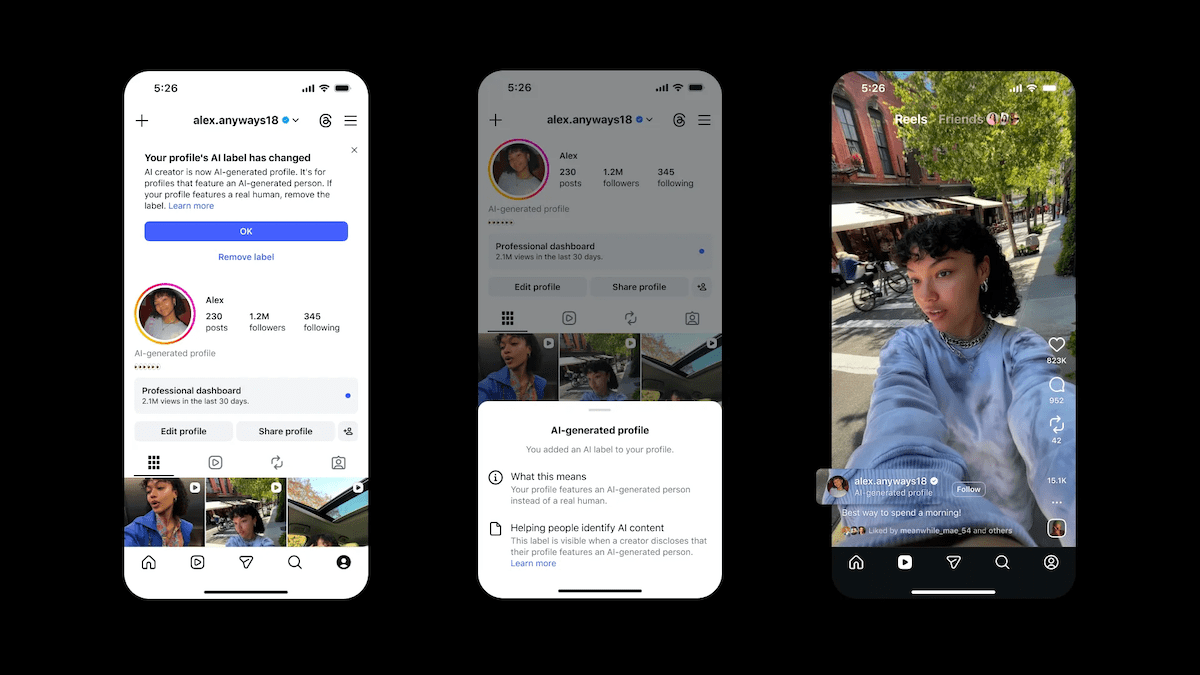
Instagram is making synthetic identity harder to hide by giving AI-generated personas a clearer profile label and threatening reduced distribution when creators fail to disclose them.
From “AI creator” to plain language
The new “AI-generated profile” wording tells users that the person depicted by an account may not exist. That is more direct than a label that could be interpreted as a human creator who merely uses AI tools.
Reach becomes the enforcement tool
Instagram says undisclosed synthetic profiles may be shown to fewer people. Reducing distribution gives creators a practical incentive to label the account without requiring an immediate ban in every case.
Profiles and posts are different problems
An account-level persona can build trust over time, while an individual generated image may be a one-off piece of content. Meta’s policy has to address both without labeling ordinary retouching as a fabricated identity.
The unanswered enforcement question
Detection remains imperfect. Sophisticated creators can mix real and generated material, and false labels can damage legitimate accounts. The policy’s credibility will depend on appeals and consistent application.
What counts as an AI persona
The policy is aimed at accounts whose depicted identity is generated or substantially synthetic, not every creator who uses an editing filter. The boundary becomes difficult when a real person repeatedly alters face, voice and body.
Clear examples and an appeal process are necessary so creators can understand whether the profile label applies to them.
Why profile-level disclosure matters
A post label tells users about one image. A profile label changes the context for every interaction, including direct messages, endorsements and apparent personal testimony.
That matters when followers form emotional relationships with a persona or believe a synthetic model has personally used a product.
The advertising implications
Brands working with virtual influencers need contracts that specify disclosure and responsibility for misleading claims. Reduced reach can damage a campaign even when the advertiser did not operate the account.
Consumer-protection rules may also apply if a synthetic testimonial implies experience the persona could never have had.
Detection will make mistakes
Metadata can be removed, images can be recomposed and some real photographs look artificial after heavy processing. Automated classifiers produce false positives and false negatives.
Meta should combine signals rather than treating one detector as proof, and it should give users a meaningful way to contest a label.
Reach reduction versus removal
Limiting recommendation is a proportional response for missing disclosure, while impersonation, fraud or threats may justify removal. Separating those violations prevents every AI-use dispute from becoming an account ban.
Transparency reports should show how often reach penalties are applied and reversed. Without data, creators cannot evaluate whether enforcement is consistent.
What users should look for
Check the profile label, biography, linked website and whether the account identifies a human operator. Be skeptical of requests for money or intimacy from a persona that cannot be independently verified.
A disclosure does not guarantee that every claim is accurate; it simply gives the audience essential context.
Sources and verification
This report was prepared from current material available on September 2, 2026. Developing facts may change, and allegations are identified as allegations.
Editorial standard
Chitran Newsroom separates confirmed facts, contextual analysis and forward-looking interpretation. Corrections are made transparently when credible new evidence changes the record.