
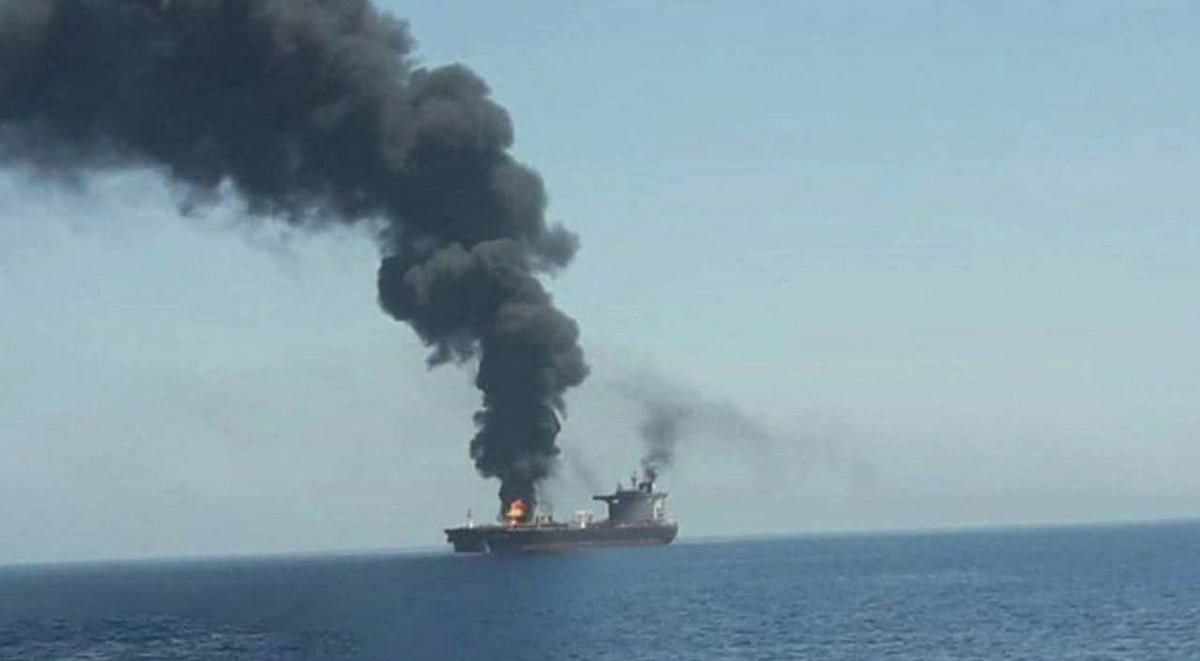
A new tanker attack forced a crew to abandon ship while U.S. strikes continued. The conflict’s decisive pressure point remains the waterway connecting Gulf energy exports to the world.
The development
A tanker was attacked in the Strait of Hormuz and its crew abandoned the vessel as the United States carried out a tenth consecutive night of strikes against Iran. The two events capture the conflict’s central strategic problem: military pressure can destroy equipment and infrastructure, but it has not yet guaranteed safe passage through a narrow waterway that once carried roughly one-fifth of globally traded oil and natural gas in peacetime.
Why it matters now
For merchant crews, the danger is immediate and personal. A commercial ship is not a warship; its crew may represent several nationalities and its cargo may be owned, financed and insured in different countries. One attack therefore triggers rescue operations, inspections, claims, route decisions and legal questions across multiple jurisdictions. Even when a vessel does not sink, damage and uncertainty can remove capacity from the market for weeks.
The essential context
The economic effect travels through insurance before it reaches many consumers. War-risk premiums can jump, underwriters may narrow coverage, and shipowners can demand higher freight rates or refuse voyages. Those costs become part of the delivered price of crude oil, liquefied natural gas and refined fuels. Traders also price the possibility of future disruption, so benchmarks can rise before a measurable shortage appears.
How the mechanism works
Alternative routes provide only partial relief. Saudi Arabia can move some crude toward the Red Sea by pipeline, and the United Arab Emirates has capacity that bypasses Hormuz, but neither system can replace the waterway’s normal volume. Ports, pumping stations and storage terminals also become strategic assets requiring protection. Rerouting can reduce exposure while creating congestion and new geographic vulnerabilities.
The pressure points
The military test is not merely whether U.S. strikes hit their intended targets. It is whether force changes Iranian behavior without widening attacks across Gulf states, American facilities or Red Sea shipping. Every additional night increases the opportunity for misidentification, retaliation or an incident that political leaders feel compelled to answer. A tactical success can still produce strategic escalation.
What comes next
Watch confirmed vessel movements, naval advisories, insurance rates, pipeline flows and diplomatic activity led by Oman, Qatar and other intermediaries. Claims from combatants should be checked against satellite data, shipping trackers and independent reporting. The clearest sign of improvement would be sustained commercial transit without attacks—not a single announcement of reopening or a short-lived fall in oil prices.
What is confirmed — and what is not
The central facts above are tied to the dated source linked in this report. Fast-moving stories often mix official statements, preliminary figures and interpretation. Readers should separate a confirmed action from a proposal, an allegation from a finding, and a target from a completed outcome. Later filings, court orders, operational data or independent investigations may revise details without making the original development unimportant.
Why the story is spreading
This story combines a recognizable institution or public figure with consequences that can be understood quickly: power changes hands, prices move, records fall or safety rules are tested. That makes it highly shareable. Popularity, however, is not verification. The most useful coverage explains the mechanism connecting the headline to people’s lives and identifies the evidence that could confirm or weaken the first interpretation.
The incentives behind the announcement
Public officials, companies, campaigners and litigants communicate strategically. They emphasize facts that support their objectives, select favorable comparisons and may leave implementation details for later. That does not make every statement false; it means readers should ask who benefits, who bears the cost, what alternatives were available and which institution can independently check performance.
How to read the numbers
Large percentages and totals require a baseline. A record can reflect a larger market, more matches, inflation, changed definitions or a genuinely exceptional result. The responsible comparison uses the same period and unit, distinguishes stock from flow, and notes whether the figure is audited, estimated or provisional. Where data remain incomplete, direction can be clearer than precision.
Who is most exposed
The burden is rarely distributed evenly. Workers with specialized jobs, households with little financial flexibility, smaller suppliers, displaced communities and countries dependent on one route or platform have fewer alternatives. Decision-makers may describe an aggregate benefit while concentrated groups absorb immediate losses. Distribution is therefore part of the result, not a secondary political argument.
What could change next
A court ruling, ceasefire, technical anomaly, exemption, budget decision or customer response could quickly alter the trajectory. Scenario thinking is more honest than a single confident forecast. The favorable case requires implementation and cooperation; the adverse case combines delay with rising costs; the middle case often produces partial delivery and continued uncertainty.
A practical verification checklist
Follow the primary source, then compare it with independent reporting and the next measurable release. Check dates, definitions, geographic scope and whether images or video show the event claimed. For legal allegations, preserve the presumption of innocence. For conflict claims, seek multiple independent confirmations. For corporate or scientific claims, look for technical documentation and reproducible results.
What Chitran Newsroom will watch
This report will merit revision if authorities change the policy, new evidence contradicts an important fact, or the promised outcome becomes measurable. The newsroom’s focus is not to preserve the drama of the first headline but to track delivery, consequences and corrections. Readers should use the cited source for the original record and return to later official releases for the current status.
Sources and further reading
This report is grounded in the primary or directly cited news record. Because this is a developing story, readers should consult the original source for later revisions and supporting detail.
Editorial independence
About this reportReporting on politics, public policy, climate and the economy is produced as independent newsroom coverage and is not connected with the educational services or teaching operations of Chitran International Online Art Classes, LLC.