
A rapidly strengthening El Niño is raising the odds of exceptional global heat and disruptive regional weather during the second half of 2026. But whether 2026 becomes the hottest year requires separating annual rankings from the timing of Pacific warming.
NOAA says El Niño conditions are present and likely to strengthen through year-end. Its July discussion assigned a high probability to a very strong event in October-December and expected it to persist into early 2027. The World Meteorological Organization has urged governments to prepare.
Could 2026 rank near the top?
Yes. The underlying climate is already much warmer because of greenhouse-gas accumulation, and recent years cluster near record levels. Even without a full-year El Niño boost, 2026 can finish among the hottest observed. Regional records can occur regardless of the final global ranking.
Calling it definitively the hottest is premature. Rankings use all twelve months and differ slightly among datasets. A late-developing event does not affect January through June retroactively.
Pacific climate engine
El Niño begins in the ocean but reaches worldwide
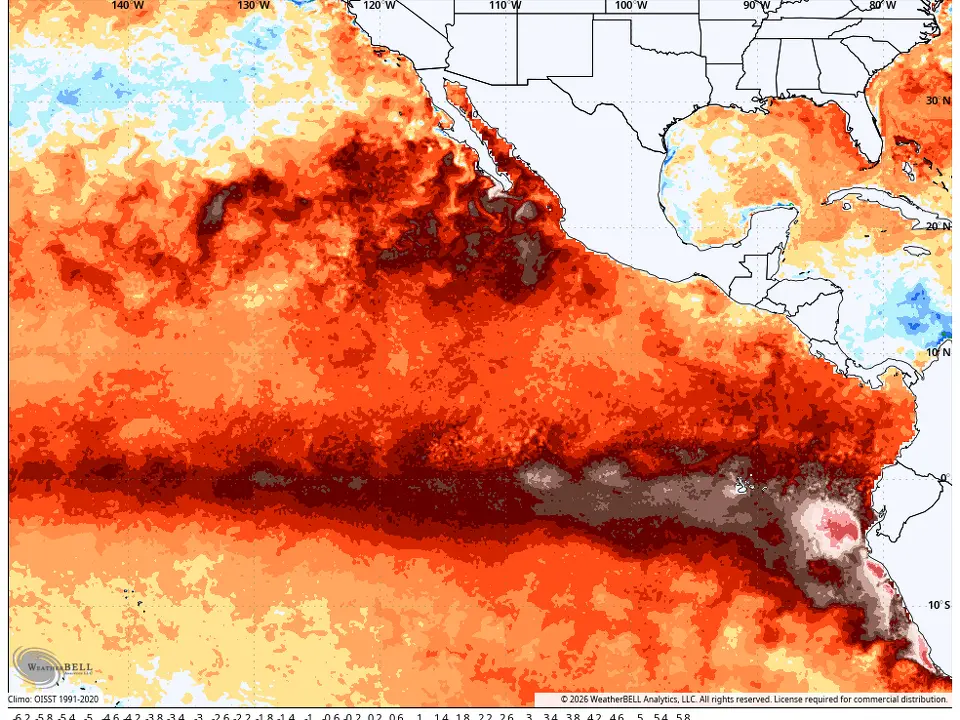
Warm water in the central and eastern equatorial Pacific changes tropical rainfall and atmospheric circulation.
How El Niño adds heat
El Niño weakens the normal Pacific trade-wind pattern, allowing warm surface water to spread east. Heat stored in the ocean transfers more readily to the atmosphere. The global average often rises during an event or the year after development.
The phenomenon is natural but now operates on top of human-caused warming. A similar ocean pattern therefore produces higher absolute temperatures than decades ago.
What a strong event can change
El Niño does not create the same weather everywhere. It can increase heavy rain in some regions and drought risk in Australia, Indonesia, southern Africa and elsewhere. It influences monsoons, wildfire conditions, marine heatwaves and tropical cyclones.
Forecasts are probabilistic. Local outcomes depend on season, event strength and other patterns such as the Indian Ocean Dipole. A strong event raises risk; it does not guarantee a particular disaster.
Why historic still needs caution
NOAA indicates a substantial chance the event ranks among the strongest in the modern record. That is not a completed measurement. Ensembles can change, and different strength metrics do not always produce identical rankings.
Scientists distinguish an extreme El Niño from extreme impacts. Ocean anomalies matter, but vulnerability, land conditions, water management and preparedness determine damage.
Preparation begins before the peak
Seasonal forecasts provide time to prepare reservoirs, health services, agriculture, wildfire planning and humanitarian supplies. Heat warnings reduce illness. Disaster agencies can inspect drainage and communications before heavy-rain seasons.
The answer
A historic El Niño could help make 2026 one of the hottest years, and 2026 may rank near the top anyway. The stronger conclusion is that late-2026 warming raises the chance of exceptional heat in 2027. The final 2026 position will only be known after complete annual datasets are analyzed.
Sources: NOAA Climate Prediction Center ENSO Diagnostic Discussion, July 2026; WMO El Niño updates, seasonal forecasts and global temperature outlooks.
Editorial independence
About this report
Reporting on politics, public policy, climate and the economy is produced as independent newsroom coverage and is not connected with the educational services or teaching operations of Chitran International Online Art Classes, LLC.
This article is published under the editorial standards of Chitran Newsroom. The content does not necessarily represent the official views of Chitran International Online Art Classes, LLC.